





In some places stories do not live in books— they live in the soil.
You do not expect the Earth to sing, but in the land of the rust-red soil, where the air smells of Palash¹ blooms, and where the echoes of the drums move across the red hills, the masked dancers move under Mahua trees², spinning tales that have lived for centuries… but it does—in the land called Purulia, it always has.
Here, tales rise with the morning fog, echo through rice fields and bloom through festivals, and two of them, one girl— who sang until the skies wept with a dance— that wears a face to be shown, never left.
Princess Bhadravati was said to be an orphan, adopted by the king of a village. She was the king’s one and only beloved daughter, the apple of his eyes. Though she was adopted, his love for her ran deeper than blood. To him, she was a treasure—gentle, bright, and full of life. She lit up his world, and he guarded her like a precious gem. His love stood like a shield, keeping every struggle away.
But her one choice changed it all. She loved.
She loved a man named Anjan, who was poor and unknown. No title nor land. To the world, he was a nobody, just a commoner, but to Bhadu—Anjan was the sun, and nothing else mattered when the sun was out. She saw him for who he truly was, not the title he lacked.
Hidden meetings beneath the stars and moonlit sky, it was all they saw, but soon their secret was found out, from whispers to rumours, to the truth being unraveled to the king. His anger was like a storm—tearing everything he had for his daughter. All he had for her was gone…in a blink of an eye.
To everyone, her love was a crime, to the king, a betrayal, but to Bhadu, it was just love. A person cannot keep their emotions bottled up, can they?
Soon, Anjan was imprisoned, cast out with nothing but their memories, and the glimpses of her. And Bhadu, she was locked away too. In a prison? No. But in silence and sorrow. She sang in despair, day and night, in the hope that he would hear her. Yet, the time arrived when Anjan was released. But she—Bhadu—was nowhere to be found. It is said that she faded away into the sky, the sky that once witnessed it all. She became a part of it. She vanished, yes. Forgotten? Never. She is remembered by the people through the songs she left behind, during the monsoon times³. Some say she brings the rain, and some say she is the rain. This might be true. Maybe she comes back, just to reunite with the land that witnessed the defeat of her love.
The wind that moves through the field and flame, still softly sings Bhadu’s name. No longer just a memory now, she lives forever in a song. But stories never end, they echo and evolve. This is where another story begins—not of a girl, but a dance—a dance, which speaks volumes, when words fall silent: Chhau⁴.
Chhau speaks in a way that words cannot. It is more than just a dance form—it’s a language made of movement, rhythm, and silence.
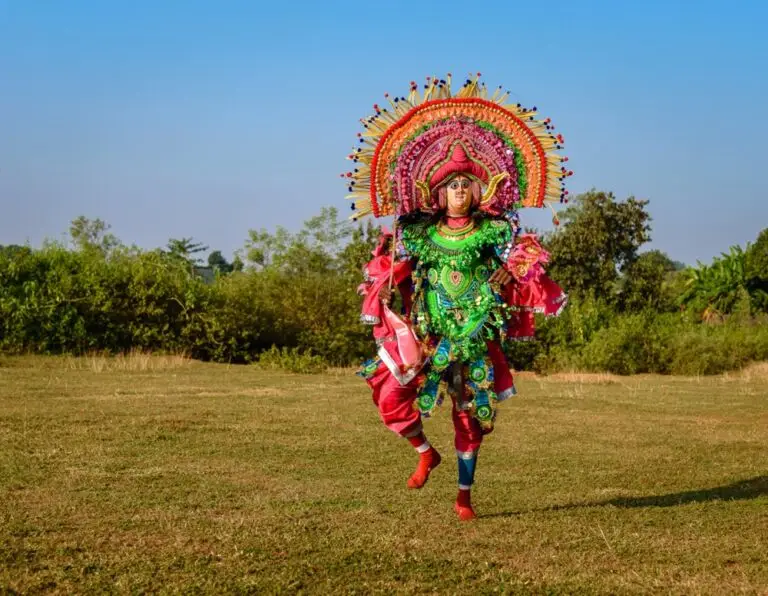
In Chhau, dancers wear large, vibrant masks that cover their entire faces. They perform old stories, like battles between gods and demons, the birth of worlds, the fall of empires, good clashing with evil. But even though the tales are old, there is something deeply personal about them.
The dancers do not show their real faces. They are not supposed to. Maybe because sometimes, your real face does not show what you’re feeling inside. The mask becomes something else—it is a shield, or a new identity, or maybe a voice when you do not have the words. Behind the mask, the dancer becomes someone different. Not pretending, but transforming. They are not acting like a god or a warrior. They become one.
The masks look heavy, carved in detail and filled with color. But the dancers somehow look weightless. Like they are floating through the air, driven by something deeper. Every step, every turn, every moment of stillness feels like it’s carrying a secret. Something the dancer cannot say, but needs to let out.
And that’s the strange part—on stage, people cheer for it. They applaud the emotions, the strength, the intensity. But outside that space, those same emotions? We’re often told to hide them. To calm down. To stop being “too much.” That is kind of unfair, is it not?
People often say that art is meant to show who you are. But sometimes, I think it shows who you cannot be. At least, not in real life. You don’t always make art because you know exactly what you are feeling, you make it because you do not, and you need some way to let it out. Chhau is like that—a way of holding things together when the world does not give you the space to fall apart.
The performances usually happen at night. Not always on a fancy stage, but sometimes just in a field or a dusty clearing. The drums start. The lights flicker. Dust rises with each beat, and then, it begins. The music gets louder, the dancer enters, and suddenly, everything else fades away. You forget you’re watching a performance. You forget there is a person under the mask. You start to believe the story. And somehow, that story believes in you, too.
Chhau is many things—a celebration, a tradition, a piece of history. But more than that, it’s a way of being seen, even when your face is hidden. A way of being heard, even without speaking.
And maybe that is what ties it to Bhadu.
She sang her sorrow into the sky, hoping someone might hear her. Now, others dance their truth into the earth, hoping someone might understand. One used a song and one used dance, but both wanted the same thing, to be known and not forgotten, Bhadu— to her lover and Chhau— to the people. Yet unknowingly, both created a deep significance in the hearts of people.
In a world that often asks us to be quiet, sometimes it takes a dance to speak, and a song to never be forgotten, and if you listen closely,when the drums rise or the rain falls, you’ll hear them still, because in Purulia, stories do not end. They return to the soil, and bloom again.
¹ a fiery red flower that blooms amidst spring.
² an Indian tropical tree found largely in the central and north Indian plains and forests
³ the season when it rains a lot in Southern Asia
⁴ A semi-classical folk dance form from eastern India, particularly West Bengal, Jharkhand, and Odisha.