





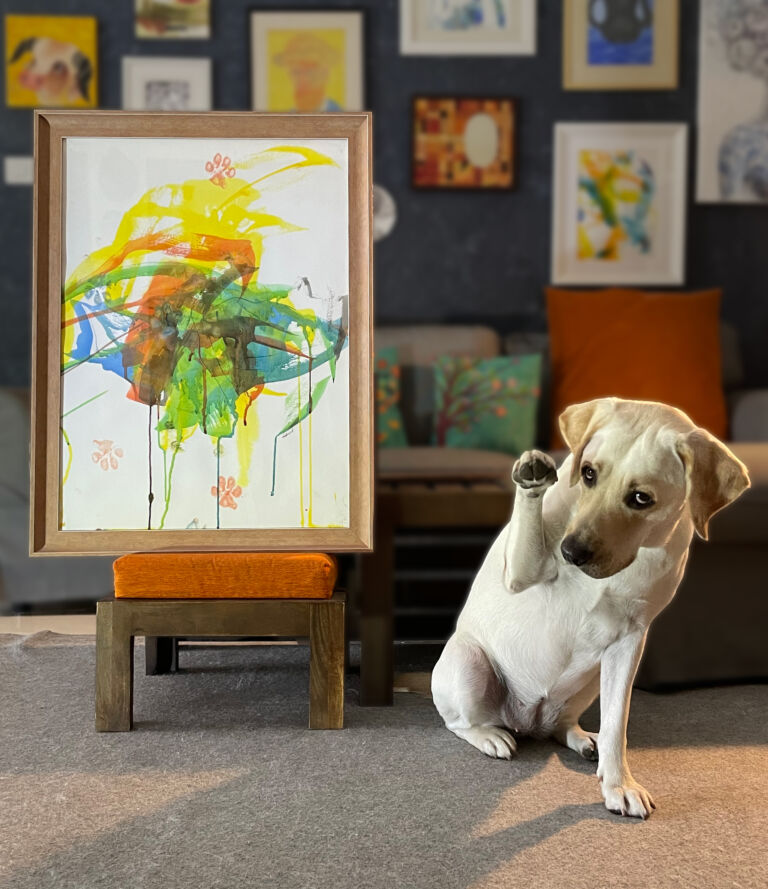
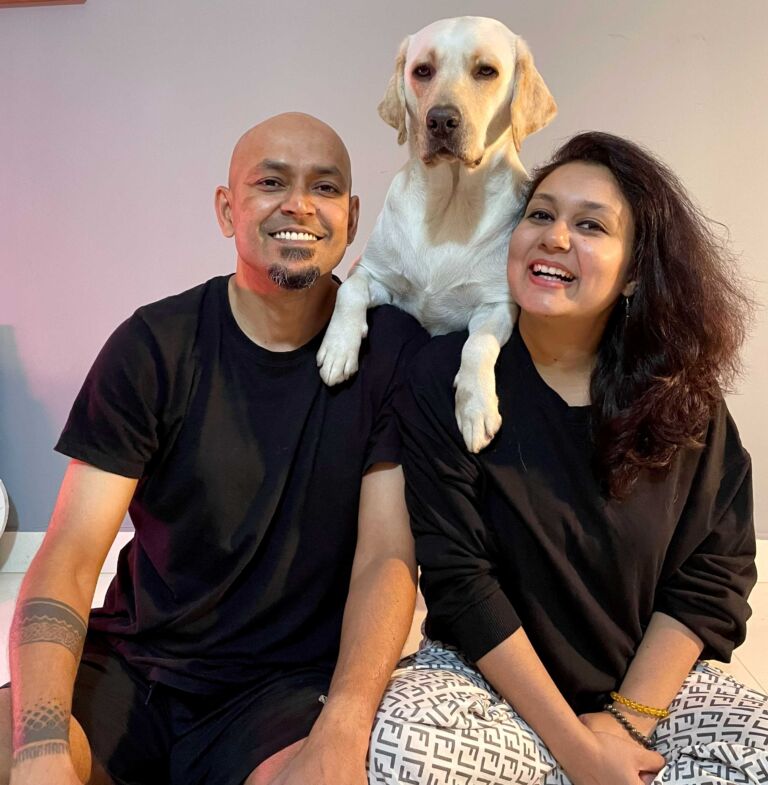
Labrador Dali—or just Dali—is an adorable furry friend who loves to paint and make art. She is a Labrador and the first artist dog in India and lives in Bangalore with her parents and baby brother, Miro. Here’s a chat we had with her parents, Hoi Choudhury and Snehangshu Debnath.
We published a snippet of our interview with them in the first issue of The Paper Planes Journal. Now, here’s the full conversation!
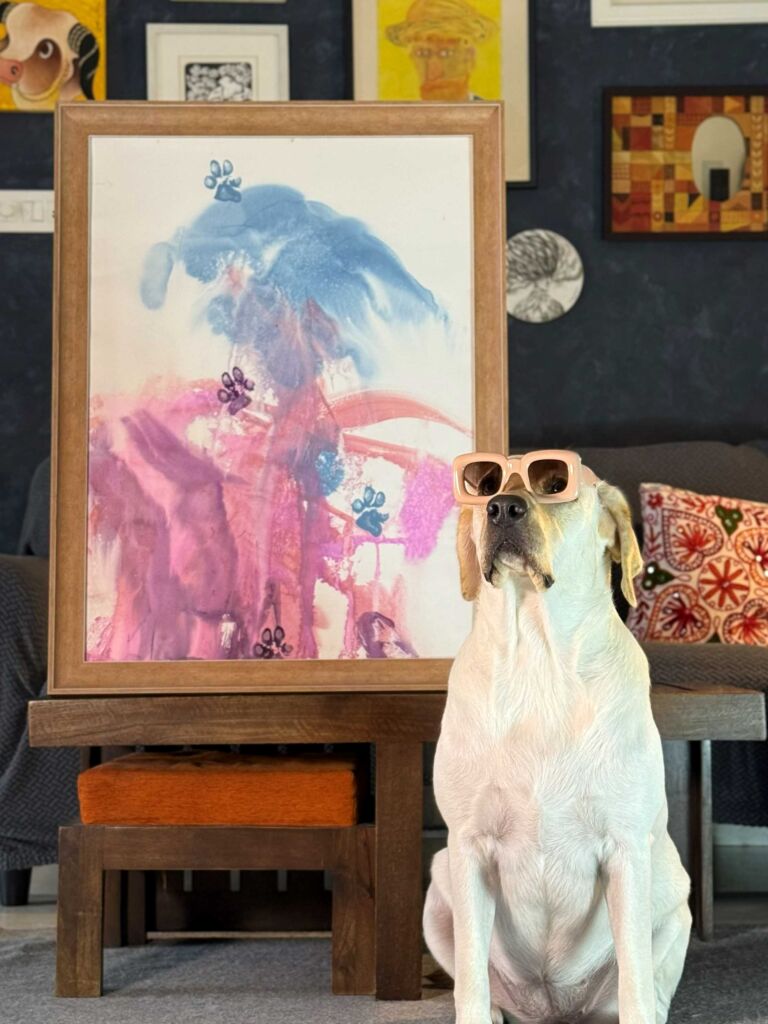
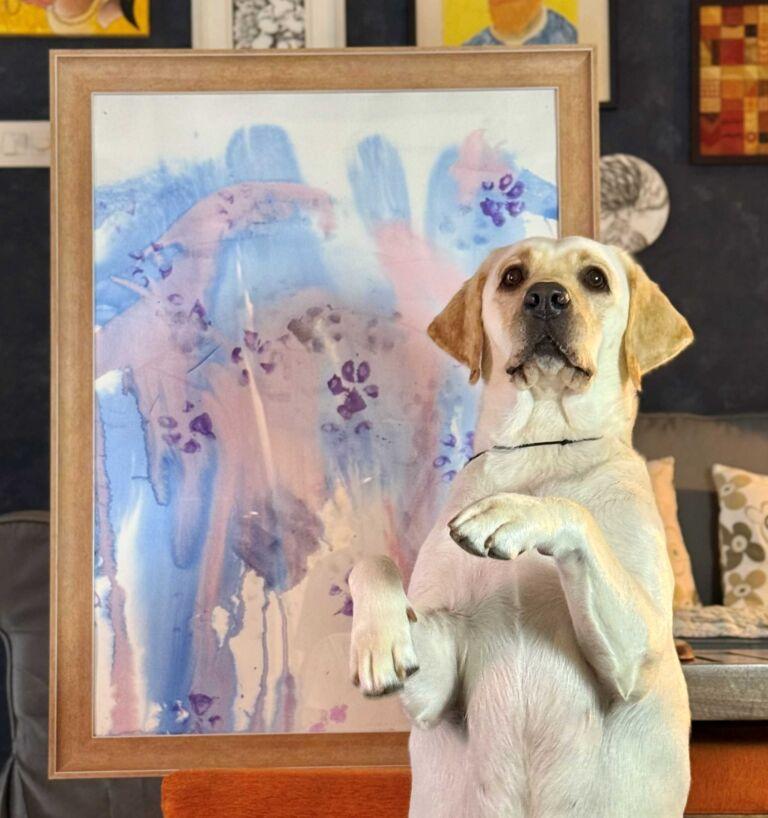
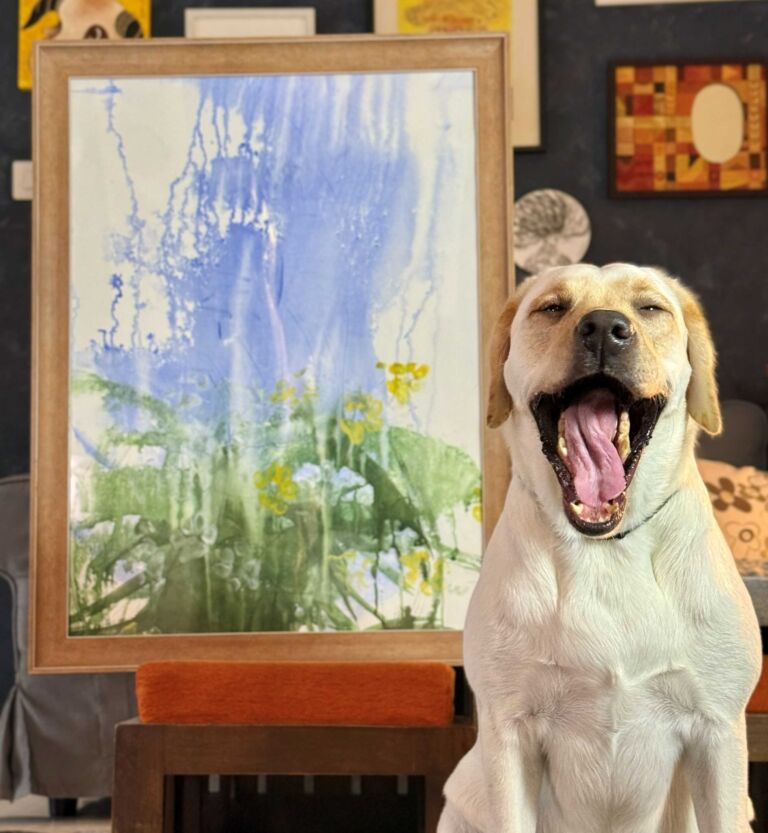
How did Dali get into painting and art?
Snehangshu: Dali is actually curious about everything; it’s not only the painting. Even if we do a small thing like packing or cleaning the house or anything, she is curious. And not only curious, she actually wants to participate in everything.
Hoi: Yeah, that’s it. We’re cleaning, we’re cooking; she wants to participate. Always, even now.
Snehangshu: So, when she was a puppy, about—well, she’s still a puppy—when she was about 7 months or so, I used to paint in my studio. And she used to come and sometimes snatch my brush. And sometimes she would do something, like try to distract me. Anything, really, she would play; she would disturb me; she would do anything to distract me. Then, we were talking about her activities with one of our common friends from Kolkata, and he suggested, ‘Why don’t you try giving her a brush?’ Maybe it’s her protest; maybe she wants to paint!
Hoi: Yeah, actually, the first time we gave her a human brush, and she literally touched the canvas with the brush, so we were extremely happy. We were like, “Woowww! She did it!” And then, the next time we gave her a brush again, and she was like, “Okay, no, I’m going to snatch it and run away.” So, after that, we did some research, and we saw that there are actually a few other dog artists, mostly in the USA and Canada. And then we found out about dog-friendly brushes, and we made one at home. We took a piece of wood and carved it and attached the brush to it, and it’s nothing but a holder along with a brush on one end. So, we gave her that, and initially, we did not give any colour to her; it was just – the first training was ‘hold and touch a surface’. And I think that’s the only training we gave her.
Snehangshu: Once she understood how to touch the canvas and work with the colour, she started enjoying it, and it became her passion. After that, it was all her choice. She wanted to do vertical strokes, horizontal strokes, circles, everything she does; it’s totally her.
Hoi: Yeah, we never gave her that training. She kind of just started with ‘hold and touch’, and then she invented those strokes all by herself. This was around when she was 7 months old. Then, around 9 months or so, we gave her colour. At 9 months, she started painting. Her first painting was around the 9th or 10th month.
But it is really amazing that you guys encouraged this and nurtured this and gave her the space to do this. Most people thinking about “Oh, there needs to be a different brush; we need to make that, okay, she is running away with the brush and not interested” they would give up.
Hoi: I would say this is mostly like parenting. How do you also parent a human child, because if a human child is also very energetic, we generally call them naughty, right? We say they are mischievous and naughty and very hyperactive. Dali is very similar to that. So, once we kind of understood that, if you give her a task, if you kind of channelise that energy, then she does that perfectly. She is very passionate about anything that you give her; if you give her any task, she’s very passionate about it. It’s like any human kid, well, the naughty ones. But once they find their passion, they are extremely passionate about those things.
Snehangshu: Actually, at the same time, it saved our lives as well. Because otherwise, she was a tiny shark.
Hoi: Yeah, she used to be a tornado in the house.
So, does Dali have a favourite colour?
Hoi: Well, it is known that, theoretically, dogs can only see blue and yellow. We have actually experimented with this, and we have seen that she enjoys blue and yellow more than other colours because the other colours are generally greyscale for her. And we know that blue is her favourite, for sure. Blue is the colour that she enjoys the most. Even though we have seen that yellow also, she is kind of able to recognise the colour.
Does Dali have any rituals before or after painting? Like a favourite snack or something that she does?
Hoi: Yeah, without snacks nothing happens in this house.
Snehangshu: Yeah, treats are a must. And also we make these treats at home for her specially, so we don’t buy them.
Hoi: Yeah, so we kind of dehydrate chicken at home, and she enjoys that. She also enjoys boiled eggs. So, that’s also her favourite.
So, I believe you have another dog, right? A little brother, Miro?
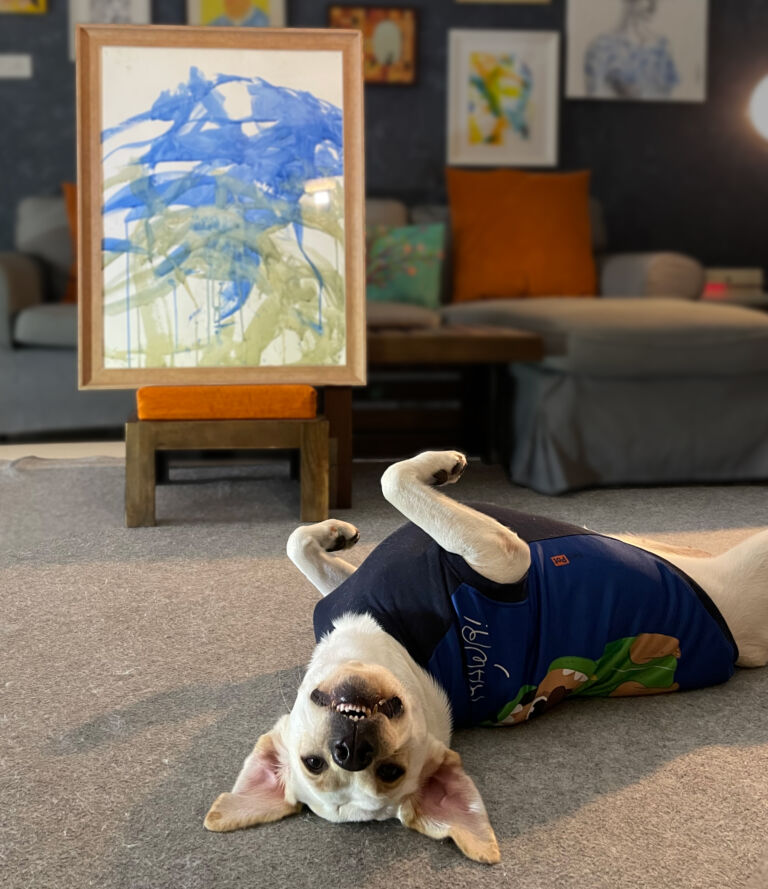
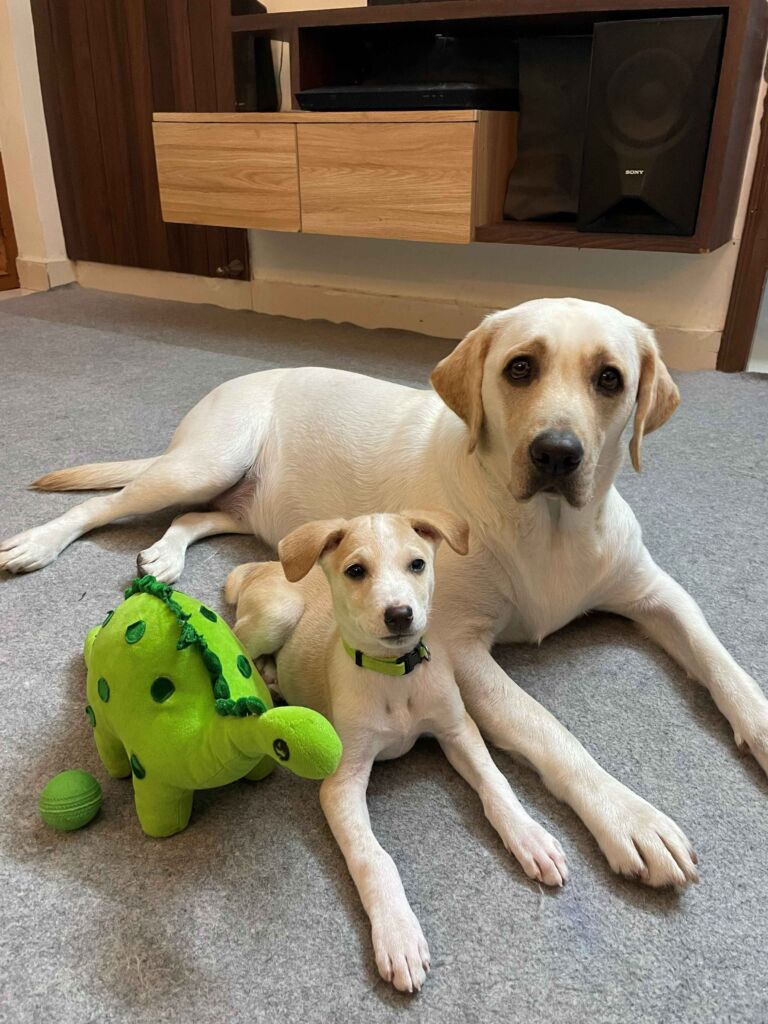
Hoi: Yes, Miro. Miro has been with us since November last year. So, Miro was 30 days old when he was hit by a car and his back leg was broken, so we rescued him from the streets, and then we—he actually went for a very critical surgery because he was really little at that time. But he survived, and he recovered pretty fast; now he is going to be one year old this October. So, yeah, he has been with us since then, and initially, we were—like, after rescue and surgery, we were fostering him. We were still thinking about whether Miro will be with us or somebody else would be interested in adopting Miro. But then, Dali kind of adopted him. Then, we got so attached we thought that, okay, no, Miro cannot be adopted by anyone else right now. He’s an Indie; Dali is a Labrador.
Snehangshu: Now Miro has taken that place, that old ‘little shark’ spot.
Does Miro have any opinions on Dali’s paintings?
Hoi: Oh, yes, yes! He is a kind of supervisor. And he’s a helper too. Like, he’s also similar to Dali. If we are setting up the studio, setting up the papers and canvas and colours, he would be running around here and there just to oversee the things. Whether everything is happening properly or not. And then, he also walks along with Dali. When Dali is painting, she generally takes rounds. She comes with the brush, touches the canvas, takes a round and then comes back, so Miro will follow her all the time.
Snehangshu: We actually tried giving a brush to Miro as well. He holds it, but he has no interest in painting. We tried, and we are still trying, but he is not showing any interest.
Hoi: He holds the brush, but then he drops it after some time.
Ah, he likes being the supervisor.
Hoi: Yeah, yeah.
So, what’s next for you guys? Do you have anything immediate planned?
Hoi: Yeah, we actually do. We have been planning this for a very long time, and it is kind of materialising right now. We are going for a road trip. With both Dali and Miro. We will be starting from Hyderabad in our car; by road we are probably going to go towards North Bengal and then Sikkim, and if possible, then the Northeast. That’s the plan.
Snehangshu: Lot, lot, lot of plans are there.
Hoi: And on the way, if everything goes well and if Dali is motivated, then she might also paint along the road. That’s probably if everything goes well; that’s going to happen sometime next month.
I hope your road trip plans go smoothly.
Hoi: Thank you, thank you.
Do you want to say anything to our young readers who are dog lovers who might or might not be interested in art?
Hoi: Yeah. So, I guess, this is the age for someone to start understanding and believing in empathy. I believe it’s very important for us as adults, as well as parents, to teach empathy to our kids. And our young readers should always keep in mind that a dog or a cat, or say, any animal – what they really want from us is just love and care. It’s everything that they live for. We have understood that from our pets, even the stray dogs around our locale. (By the way, we are also rescuers. We have vaccinated and sterilised all the stray dogs around our location). And I think it’s really important for the next generation to understand the good things that might happen after a few years if we start today. It takes time. Because, say, of what’s happening right now in India, there has been sudden disruption about this stray dog problem. So, our point is that dogs have a very short life. Once they are sterilised, vaccinated and released back, they are safe. And once they are properly cared for, they won’t be a problem for humans. They would protect the neighbourhood. Once you give them that time, it’s the natural 15 years of their lifespan which they would spend, and then slowly the population will be under control. That’s something we believe. We believe in compassion; we believe in empathy. And I believe that the next generation should also have compassion. And talk more and learn more about empathy.
You can follow along on Dali and Miro’s future adventures on their Instagram @im.labrador.dali and YouTube by the same name!